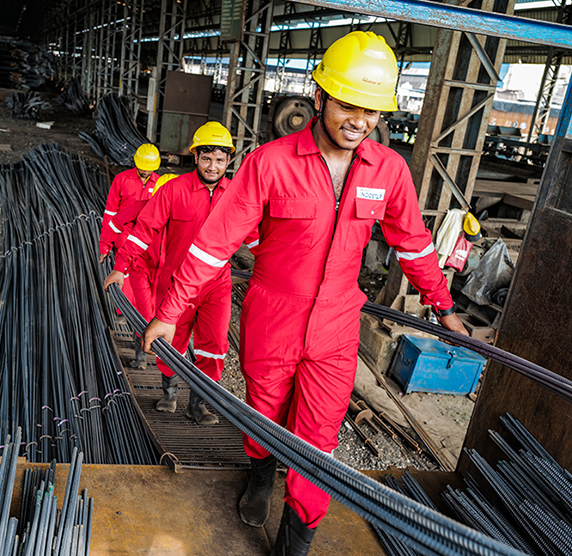
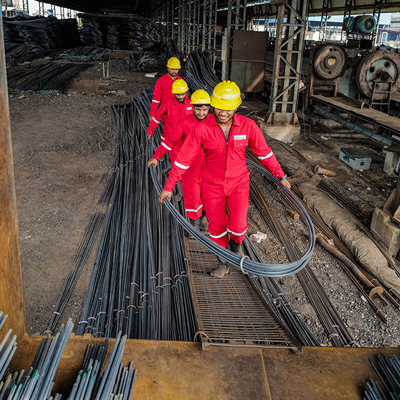
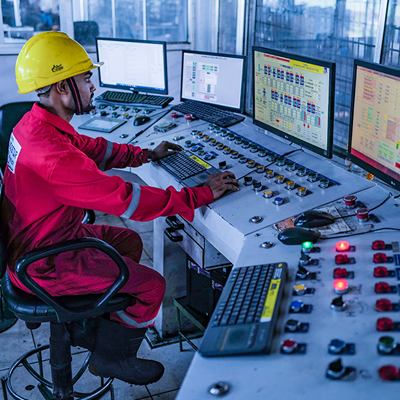
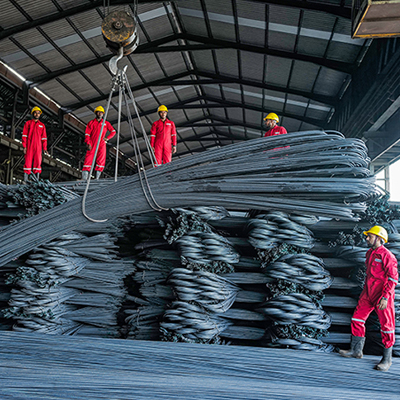
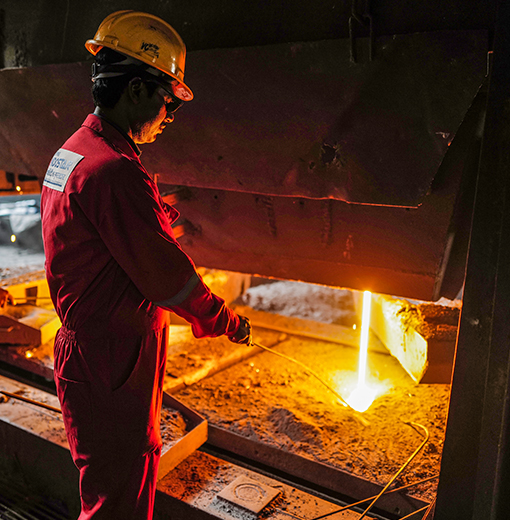
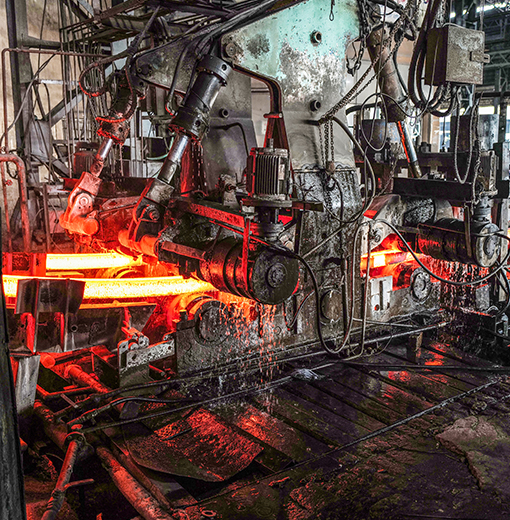
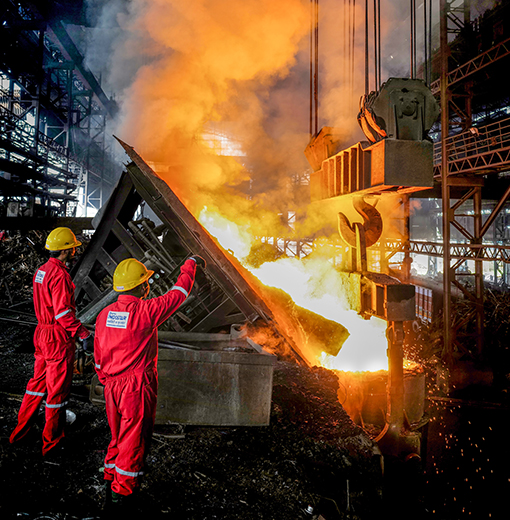
The Galwalia Ispat Udyog Private Limited (GIUPL), established in 2005, is an iconic Steel Manufacturing Company in the country. GIUPL is a strong contributor towards the country's 'Make in India' effort aimed at making our nation self reliant in manufacturing. Built on ethos and legacy of excellence in what it produces, Galwalia Ispat Udyog Private Limited has a modern & technologically up-to-date manufacturing facility at Kashipur, producing the highest quality TMT bars under the brand name INDOSTAR .
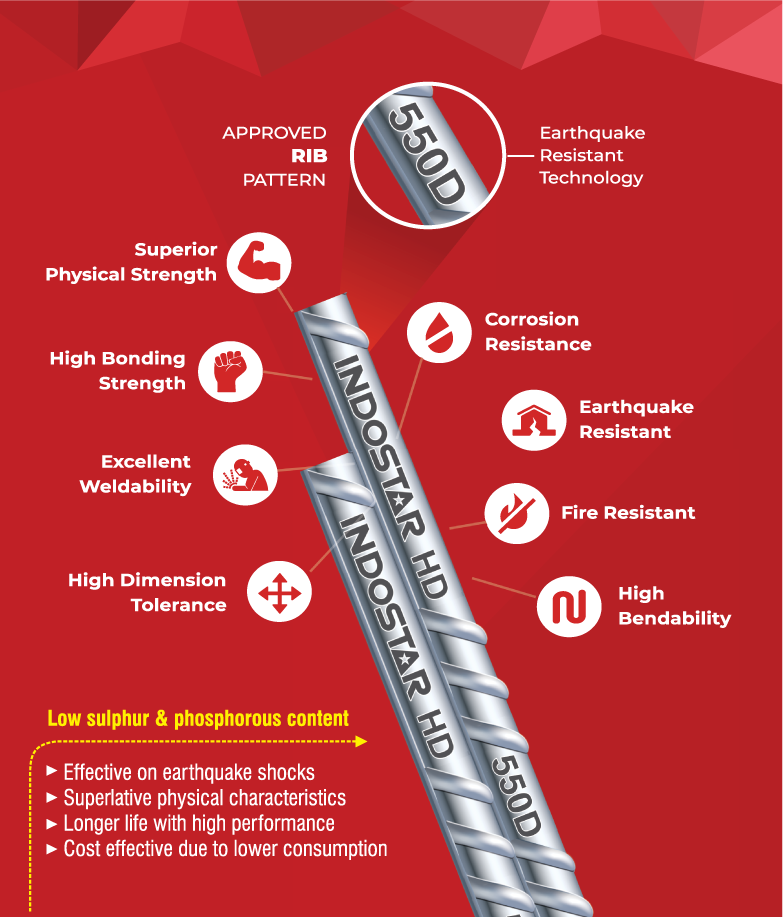
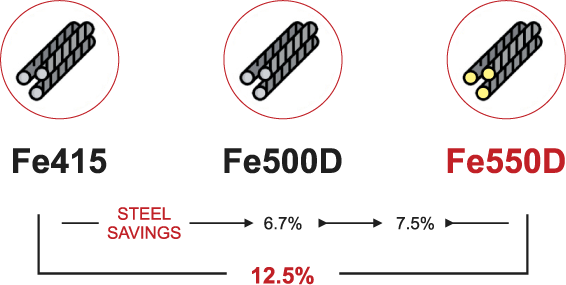
D-grade steel is more frequently utilised in earthquake-prone locations because of how robust it is to seismic activities. According to IS 1786, Fe 550D complies with the chemical requirements with low Carbon, Sulphur, and Phosphorus that enable TMT to gain more ductility that helps the steel to be preserved and resistant to seismic shocks.
TMT manufacturing process results in a steel product with a solid outer shield that gives the TMT steel bar the requisite strength and a soft inner core that gives it the necessary flexibility to survive the destruction caused by an earthquake's earth-shaking activity.
| Elements | IS 1786:2008 AMEND.NO. 4 Fe 550D |
INDOSTAR Fe 550D | LEADING BRAND |
|---|---|---|---|
| % C (Max) | 0.25 | 0.24 | 0.25 |
| % S (Max) | 0.04 | 0.03 | 0.035 |
| % P (Max) | 0.04 | 0.03 | 0.035 |
| % (S+P) (Max) | 0.075 | 0.065 | 0.070 |
| CE (Max) | 0.42 | 0.35 | 0.42 |
| Product Attributes | IS 1786:2008 AMEND. NO. 4 Fe 550D |
INDOSTAR Fe 550D | LEADING BRAND |
|---|---|---|---|
| YS (Min) Mpa | 550 | 590 | 580 |
| UTS (Min) Mpa | 600 | 660 | 640 |
| (UTS/YS (Min) | 1.08 | 1.11 | 1.10 |
| %티 (Min) | 14.5 | 20.0 | 19 |
| % Total El (Min) | 5 | 9 | 9 |
*Value Meets the requirement of IS1786:2008 Amnd No.4 however the actual result will have improved values which will be reflected in MTC.
This is a process that is divided into three stages. Here’s a closer look:
Machine (CCM) for conversion of molten steel metal into billets of various sizes.
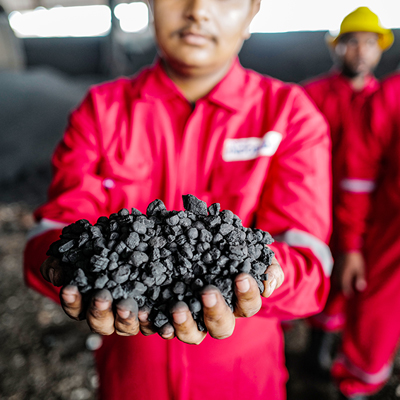
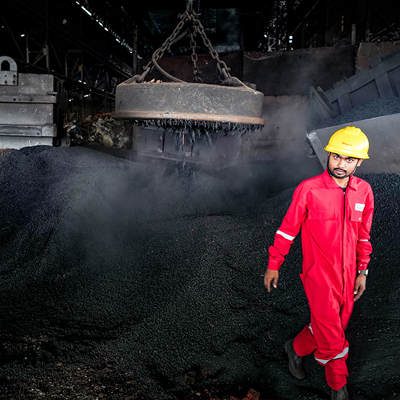
The raw materials which are used for making steel are sponge iron,Silico Manganese,Metcoke. Sponge iron is basically deoxidized iron in the form of lumps, pellets and fines. Sponge iron and steel scrap are charged in appropriate ratio into the induction furnaces in batches.
After the complete melting of charge, the hot liquid metal samples are taken to analyse the chemical composition i.e. carbon, sulphur, phosphorus, silicon, manganese, etc. In order to balance the chemistry of the metal as per the required grade, silicon, manganese and ferrosilicon is added. The temperature of liquid metal is raised to 1600 degree centigrade for casting.
For billet casting, liquid steel is poured into the ladle and the ladle is taken to CCM for casting.
Complete Process route for SMS Section
Charging | Melting | Removal of slag
Tapping | Refining | Casting
After the casting of billets in required sizes, they are further processed to form TMT. There are 2 processes for manufacturing of TMT:
THROUGH HOT CHARGING | THROUGH REHEATING PROCESS
SIZE CONVERSION PROCESS: The thoroughly tested billets are either reheated or hot charged under a specified temperature. They are then subsequently rolled through a roughing stand and a sequence of rolling stands which progressively reduces the size of billets in the desired TMT size. The gradual reduction is an important factor to ensure finer grain structure of the bar. The rolling continues till the desired size is achieved.
QUENCHING and NORMALISING PROCESS: The bar after leaving the last rolling stand is fed to a quenching box at a very high speed. In this section, rapid and controlled water quenching is performed reducing the temperature of the surface drastically from around 950 to 600 degree centigrade. Due to higher speed, only the outer portion gets quenched but the inner core remains hot. The outer case due to rapid quenching gets converted into martensite form. The microstructure is fine grained ferrite and pearlite structure at the core and martensite at case. The bar is cut with automatic flying shear and fed into the cooling bed.
At the cooling bed, the core which is still hot transfers the heat outside to the case thereby tempering it. Due to this self-tempering, the martensite case becomes tempered which has more strength and high corrosion resistance properties. Both quenching and self-tempering lead to typical microstructure of TMT bar, that is, fine grained ferrite-pearlite structure at the core and tempered martensite at case. After this, the normalizing process starts where the bars cool down at atmospheric temperature and gradually attain the microstructure.